In the chaos of World War II, survival often depended on time. A wounded soldier could lose his life long before reaching a field hospital — not because surgeons lacked skill, but because blood could not reliably travel where it was needed.
Before the war, blood transfusions were still limited by logistics. Whole blood spoiled quickly. Transportation systems were inconsistent. Military medicine struggled to move lifesaving supplies across oceans and battlefields. But at the University of Iowa, a group of physicians and researchers began developing methods that would help change that reality.
Among them were Robert C. Hardin, M.D. (35BS, 37MD), and his mentor, Elmer L. DeGowin, M.D., two UI physicians whose work in blood preservation and transfusion medicine would become critical to the Allied war effort.

Hardin, born in 1913, earned both his undergraduate medical degree and medical degree at the State University of Iowa during the 1930s. He later completed residency training at University Hospital, where he worked with DeGowin, one of the university’s most respected internists and a pioneering figure in transfusion medicine.
DeGowin had already established himself as a nationally recognized physician-scientist by the late 1930s. His research focused on blood preservation, blood typing, transfusion techniques, and the clinical treatment of shock; fields that would become urgently important during wartime. At Iowa, DeGowin helped create one of the nation’s early hospital blood-banking programs and worked to demonstrate that stored blood could be transported safely and effectively over long distances.
Hardin worked closely with DeGowin during his residency years, participating in studies that advanced the understanding of preserved whole blood and large-scale transfusion systems. Those investigations helped establish practical procedures for collecting, refrigerating, transporting, and administering blood under difficult conditions.
As the United States entered World War II, military planners recognized that advances in blood storage and transfusion could dramatically improve survival rates among wounded soldiers. Hardin left Iowa to join the Army Medical Corps and quickly assumed a major leadership role. Still in his 20s, he became commanding officer of the European Theater of Operations Blood Bank and served as senior consultant for shock and transfusion.
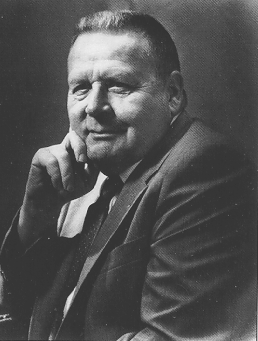
Hardin played an important role in organizing blood-banking operations to meet the great demand for blood products necessary for the invasion of Normandy and the remaining months of World War II. For this outstanding leadership he was awarded the Legion of Merit.
DeGowin’s collaboration with the U.S. Army and Navy’s Shock and Transfusion Service connected University of Iowa research to the military’s rapidly expanding blood-banking operations. Medical historians have credited DeGowin with helping develop and refine procedures for blood preservation and transfusion that informed wartime military protocols.
Military medicine during World War II increasingly depended on the ability to stabilize wounded troops quickly, especially after large-scale invasions and combat operations across Europe. Advances in transfusion medicine, plasma preservation, refrigeration, and transportation allowed medical teams to treat hemorrhagic shock more effectively than ever before. By the time Allied troops landed in Europe, blood banking had become a cornerstone of battlefield medicine.
Hardin and his colleagues helped build the systems that made that possible. Together, UI physicians helped move blood transfusion medicine from an experimental practice into a dependable wartime system.
The mentor-and-student relationship between DeGowin and Hardin reflected the broader culture of Iowa medicine during the era. Faculty researchers trained young physicians not only in clinical care, but also in the rapidly evolving science of laboratory medicine and medical logistics.
The UI’s contribution to wartime medicine extended well beyond a single physician. UI faculty members and researchers became part of a broader national mobilization of medical science during the war years. Universities across the country redirected laboratories, hospitals, and research programs toward military needs. What is now known as the UI Carver College of Medicine emerged as an important center for clinical research and physician training.
DeGowin stood at the center of much of that work. During World War II, he served as a consultant in transfusion medicine to the U.S. Army Surgeon General’s Office and became one of the nation’s leading authorities on blood banking and the treatment of traumatic shock. His research and organizational leadership helped standardize blood transfusion practices at a time when the military desperately needed reliable systems for treating wounded soldiers.
During World War I, many soldiers died from blood loss that today would be considered treatable. By World War II, improvements in blood preservation, mobile collection units, and transfusion protocols allowed frontline medical teams to intervene more rapidly. Many veterans survived long enough to return home because blood reached them in time.